
Thinking Up a Design
2.1 Introduction Thinking up a Design
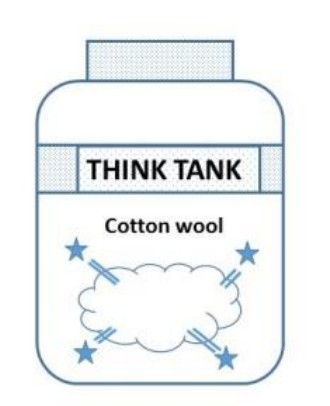
The glass jar and piece of cotton wool are used on the first day of the three-day workshop. This is the day on which we tackle the fascinating and challenging task of thinking up a design (activity 4.1).
The cotton wool represents the starting point of the thinking-up process — a rather vague, emerging idea (or bundle of rather vague, emerging ideas) for a 'plan, structure and strategy of instruction' for the course or lesson in mind.
The jar represents the designer's own internal 'think tank' in which one idea after another will form, incubate, gain favour, lose favour, crystallise, regress, be tested, be thrown out, be worked on, put on the shelf for future reference, and so on until one idea is hit upon which is it. Since everything to do with thinking up, working out and testing-and-revising a design begins in the designer's 'think tank', the three-day workshop has come to be known as the Think Tank workshop. Day two of the workshop handles the task of working out a thought-up design, and day three the task of testing and revising a thought-up, worked-out design. Thinking up a design for a course or lesson is an intuitive, creative and logical process.
Since it is a creative process, it will not run smoothly from beginning to end. It follows the pattern Stein (1974) ascribes to any creative thinking process:
'The process does not run smoothly from start to finish. Work may be halted from boredom, fatigue, not knowing how to proceed, etc. Nevertheless, it continues or incubates on unconscious or non-conscious levels and from this work or from a test of this work there is a growing conscious awareness of a new possibility that illuminates and 'lights up' a new direction, another approach, a different pathway to the solution, which the individual did not see before.
'An experienced designer soon learns to 'sense' when she or he is on the right or wrong track. This is intuition at work. Richness of ideas, ingenuity in seeking a solution to the problem (the choice of an optimum design), and originality come from the designer's creativity. The disciplined weighing, testing and selection or rejection of ideas is based on goal-directed logical thinking. Intuition, creativity, and logical thinking are at work in a designer's think tank.
Although the born teacher, designer or teacher-designer comes up intuitively, creatively and logically with effective designs for class lessons, laboratory exercises, projects, group sessions, periods of observation in practice, and so on, most of us are not so naturally gifted. We need something to help us think up an optimum design.