
Why publish Tony Earl's Book on this website?
In higher education, the need for effective, efficient, valued and well-liked courses is growing. More students must pursue higher education in a shorter period, and the use of IT and AI in education requires well-designed courses. Most teachers in higher education must develop their own courses or modules. There are no 'methods' like primary education in secondary education. Sometimes, teachers will use courses or modules designed by colleagues. They follow the didactic design step by step with minor changes in exercises or content. Or they adapt the didactical design to their specific context.
But what do you do if you are not satisfied with your course design or when the didactical approach in a curriculum is changed and there are no clear-cut and easy-to-use examples?
An very interesting and usefull design approach is presented in the book The Art and Craft of Course Design written by Tony Earl. Now available in this website.
Tony Earl wrote this unique book in 1987.
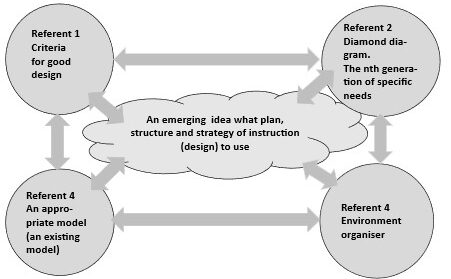
Why do we think publishing his book on the Internet is meaningful?The book reflects Tony Earl's ideas about course design. He was not a conventional education scientist. He used scientific results but added concepts, models and heuristics to enable a systematic and design-oriented approach. He forced you to think outside the box with the help of some crazy ideas like the Think-Tank, the Four Referents, the Response Environment Organiser (REO), and the Melody of a Course. His tools stimulate systematic and creative thinking. Colleagues considered Tony Earl an excellent teacher and instructional designer. In his workshops and, finally, in his book, he explains how he did the job.
One of the reviewers of Tony's book at the time of publishing gave this clear remark:
'You need skills like formulation of learning objectives and making a task analysis, but you should also be able to use your imagination and intuition. This focus on art is exceptional and often missing in course design.
The reviewer continues with the remark that 'the process, instruments and skills for craftsmanship reflect the creativity and intuition that are given a place in design. Concepts like art, intuition and imagination are not often used in instructional design theories. But in course design, these concepts are fundamental.'
So...e learned from him how to design a higher-education course that worked. We cannot copy him, but he offers us some excellent ideas for the fast and efficient (re)design of a course. We strongly believe that these ideas will help teachers (re)design courses that align with modern ideas about higher education and with their views on good higher education.
July 2014, Jan Nedermeijer, Ans Ronduite and Pierre van Eyl.
Contact: jannedermeijer@hotmail.com